Guide 01 Basics
What is an environmental portrait?
The setting carries half the story. How to pick it, frame it and keep the person from getting lost in it.
An environmental portrait is a picture of a person in a place that explains something about them. The setting is part of the subject. A headshot tells you what someone looks like; an environmental portrait tells you what they do, what they care about, or where they spend their days. A cobbler surrounded by lasts and half-soled boots. A retired teacher at a kitchen table covered in crossword books. A barista at the end of a shift, sitting on an upturned milk crate behind the shop.
The idea is old. Documentary and magazine photographers have worked this way for most of the last century, because a reader understands a person faster when the room does some of the explaining. The genre suits X well for the same reason: a single frame has to make sense in a fast scroll, and a picture with a clear place in it gives people something to hold on to.
What separates it from a regular portrait
Three things usually change.
First, the frame is wider. The person often fills a third of the picture or less, and the rest is their surroundings. That is a big shift if you are used to tight portraits, where everything except the face is blurred away.
Second, the background is chosen, not avoided. In a studio headshot, you remove distractions. Here you decide which objects stay in because they say something, and you move or exclude the ones that don't. A wrench on the bench stays. A plastic bag of trash next to it goes.
Third, depth of field gets deeper. If the setting matters, it has to be readable, so you stop down to f/4 or f/5.6 for the wide frame instead of shooting wide open. The face still needs to be the sharpest thing in the picture, but the room shouldn't dissolve into mush.
Choosing the place
The best setting is where the person already spends time, doing something they would do whether or not you were there. Ask them where they feel most like themselves. People usually know immediately.
Before you shoot, walk the space for a few minutes and look for three things:
- One strong background: a wall of tools, a window, a doorway, a bookshelf. Something with shape and some order to it.
- Light you can work with, such as a window you can put to one side of them, or an open door. More on this in the lighting guide.
- An object they touch, so their hands have a job.
Clutter is the most common problem. A real room has a lot in it, and a camera flattens everything into one plane, so a pile of things behind someone's head can turn into a lump growing out of their ear. Move a few objects if the person is fine with that. Usually two or three small changes do it: a coat off a chair, a mug out of the corner of the frame.
The four frames worth making every time
You won't know which picture works until later, so make a small set. These four cover most situations, and the shoot planner on our home page builds them for you based on your light and gear.
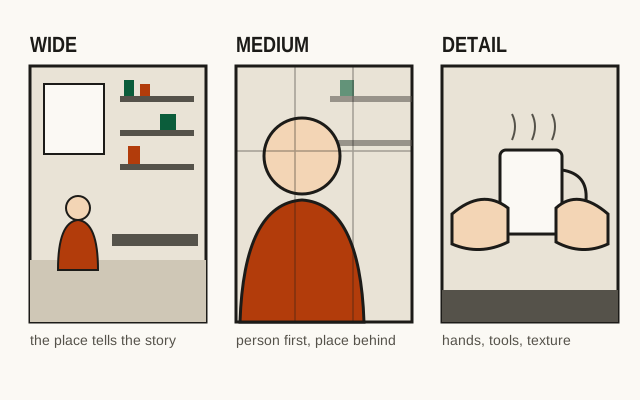
Wide
Person plus place. Put them off-center, roughly on a third, with the most telling part of the setting on the other side. Check every corner of the viewfinder before you press the shutter. Corners are where the stray chair legs and exit signs hide.
Medium
Waist up or chest up, with the background still recognizable. This is often the strongest single picture because it balances face and setting. On a 35mm lens you'll be standing a meter or two away.
Detail
Hands on a tool, a worn pocket, the label on a jar they made. It works as the second image in a post and often says more than a face would.
Candid
The moment after the posed frame, when they relax, laugh or go back to what they were doing. Keep the camera up. You will get it if you wait.
Common mistakes
The person disappears
If they fill a tiny corner of the frame and the room is busy, viewers don't know where to look. Light, contrast or a clean patch of background behind the head fixes this. If you can't separate them, move closer.
Wide-angle stretching
Lenses wider than about 28mm (full-frame equivalent), and the 0.5x camera on a phone, stretch anything near the edges. Keep the person away from the corners, or step back and use a longer lens. Our phone guide has a diagram of this.
Posing them like a headshot
Arms crossed, square to the camera, chin up: it looks stiff in a real room. Give them something to do. Lean on the counter. Check the oven. Thread the needle.
Forgetting what the room reveals
A home or workplace shows a lot: addresses, mail, family photos, a laptop screen, a staff rota with names on it. Before you share anything, look at the frame as a stranger would. The sharing guide has a checklist.
How long a shoot takes
For one person in one place, twenty to thirty minutes is enough for most environmental portraits. Spend the first five looking around and talking, ten making the wide and medium frames, and the rest on details and whatever happens naturally. Nervous subjects do better with shorter sessions. Start with the details and the wide frame, where their face is small, and show them the back of the camera early so they can see it's going fine.
Afterward, send them a couple of frames, even if you haven't finished editing. It is the easiest way to keep the door open for the next shoot, and it gives them a chance to say if there is anything in the frame they would rather not have online.
Questions
What lens is best for environmental portraits?
A 35mm lens on a full-frame camera (about 23mm on APS-C, or the 1x camera on most phones) is the usual choice because it shows the room without stretching the person. A 28mm works in tight spaces; a 50mm suits larger rooms and outdoor scenes.
Should the subject look at the camera?
Make both kinds. A direct look feels like a meeting with the person; a frame where they are absorbed in work feels like you are watching them in their world. Many photographers lead with the direct look and keep the candid one as the second image.