Guide 02 On the street
How to approach strangers for a street portrait
What to say, where to stand, how to take a no, and how to make the most of two minutes.
Most people who want to make street portraits aren't held back by their camera. They are held back by the ten seconds before they speak to someone. The good news is that asking is a skill, and it improves quickly with practice. The method below is simple, and it works in most cities and towns where people are used to cameras.
Pick people who have a minute
Timing does most of the work. Someone waiting for a bus, sitting on a bench, standing outside their shop or walking a dog slowly has time. Someone striding to the train with headphones on doesn't. You'll get more yeses in quiet streets in the late morning or early evening than at a rush-hour crossing.
Look for a reason to ask. It might be a coat, a face, a pair of hands, the way they stand in a doorway, or how well they fit the background. You'll need that reason in a moment, so name it to yourself before you walk over.
Approach from the front
Come toward people from where they can see you. Walking up from behind, or from the side while they're looking at a phone, makes anyone jumpy. Stop at a normal talking distance, a meter and a half or so, and hold the camera low, not pointed at them.
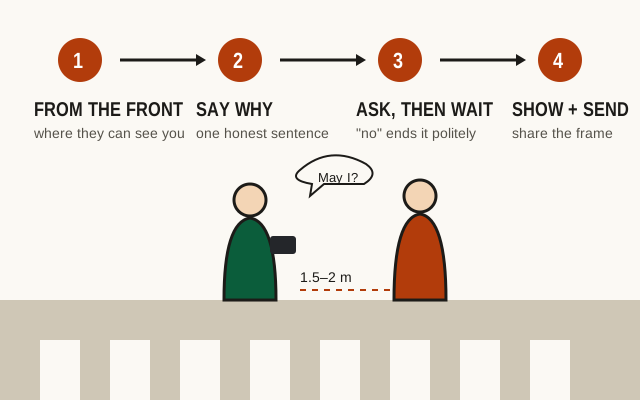
Say why, in one sentence
What you say should be short, true and specific. Something like:
"Hi, sorry to bother you. I'm taking portraits of people in this neighborhood and I love how you look against that blue door. Could I take a couple of photos? It'll take about a minute."
That sentence does four jobs. It says who you are (a person doing a project, not a company). It gives a specific reason (the door, the coat, the light). It asks a question they can answer. And it names a time limit, which matters more than people expect. A minute sounds manageable; an open-ended request doesn't.
Vague compliments don't land well. "You look interesting" sounds odd coming from a stranger, while "that jacket with this wall is a great combination" sounds like what it is.
Ask, then wait
After you ask, stop talking. Silence feels long, but people need a second to decide. If they hesitate, offer something concrete: show a frame you made earlier on your camera or phone, or tell them where you'll post it. "I put them on X as part of a neighborhood series" is useful information. So is "I won't post it if you'd rather I didn't."
If they say no, thank them and walk away. Don't negotiate. A polite no costs you nothing, and pushing makes the next approach harder for you and for every photographer after you.
If they ask why you want their picture, answer honestly. If they ask what you'll do with it, say exactly that. If you might sell prints or use it commercially, say so now. That use needs a signed release, which the consent guide explains.
The two minutes you get
Once someone says yes, you have their attention for a short time. Use it well.
Keep talking. Ask where they're headed, how long they've lived there, what they do. Conversation relaxes faces, and the best expression often comes just after they've answered a question.
Move them if the background is wrong, but do it in one step. "Could you take one step to your left, so the door's behind you?" is fine. Repositioning someone three times turns a friendly minute into a chore.
Shoot more than one frame. Make a medium portrait first, then step back for a wider one that shows where you met, then one close frame if they're comfortable. Most photographers get the keeper in the second half of the sequence, once the person has stopped holding their breath.
Check your settings before you walk over. On a bright day, shutter priority at 1/500 s or aperture priority around f/4 with auto ISO means you won't be fiddling with dials while they wait. The planner on our home page suggests ranges for your light and lens.
Show them and offer to send it
At the end, show them the back of the camera. This is the moment most people decide whether they enjoyed it. Offer to send them the photo, and ask how they want to receive it: an email, a direct message, or the X handle they'd like to be tagged with. Some people want their handle on the post; many would rather not be named at all. Ask, and write it down while you're still standing there.
If they have changed their mind by now, delete the frames in front of them. It happens rarely, and handling it graciously is worth more than any single picture.
Candid first, ask after
Some photographers make a candid frame first and then approach the person to show it. That can work, especially for moments that would disappear if you spoke first. The rule is the same: show the picture, explain what you plan to do with it, and delete it if they ask. Keep candid-first approaches for adults in clearly public places, and never use them on children.
Places and people to skip
Some situations aren't worth the trouble. People who are clearly distressed, people in a medical setting, kids without a parent who agrees, and anyone who is obviously trying to avoid attention are all better left alone. Private property such as malls, train stations and some plazas can have their own rules about photography, and staff can ask you to stop. When they do, stop.
It gets easier
The first ten approaches are hard for almost everyone. After that, most photographers find the rhythm. Some go out with a target, like five asks before coffee, which takes the pressure off any single one. Others shoot with a friend for the first few outings. Whatever you do, keep the compliment honest and the request short. People can tell when someone means it.
Questions
Should I ask before or after taking a street portrait?
For a posed portrait, ask first. If you made a candid frame before speaking to someone, show it to them and ask whether they are happy for you to keep and share it. Delete it on the spot if they are not.
How many people say yes?
It varies with the place, the time of day and how you ask. Many photographers find that a clear, specific compliment and a short request get far more yeses than a vague one, and that a calm, unhurried street works better than a rush-hour crossing.