Guide 03 Consent
Consent and model releases for portraits: US and UK basics
When spoken consent is enough, when you need a signature, and what a simple release covers.
This guide sets out the general rules that apply to portrait photographers in the United States and the United Kingdom. It is background reading, written for hobbyists and people starting out, and it is not legal advice. Laws differ between US states, between the nations of the UK, and from one situation to the next. If money, a client or a dispute is involved, talk to a lawyer who works with photographers.
Two separate questions
Photographers often mix up two things: whether you may take a picture, and what you may do with it afterward. The rules for each are different.
Taking a photo in a public place is generally lawful in both countries. Nobody has a general right not to be photographed on a public street. That freedom has limits (harassment, voyeurism, and places with their own rules, like courts or some government buildings) but ordinary street and environmental photography sits well within it.
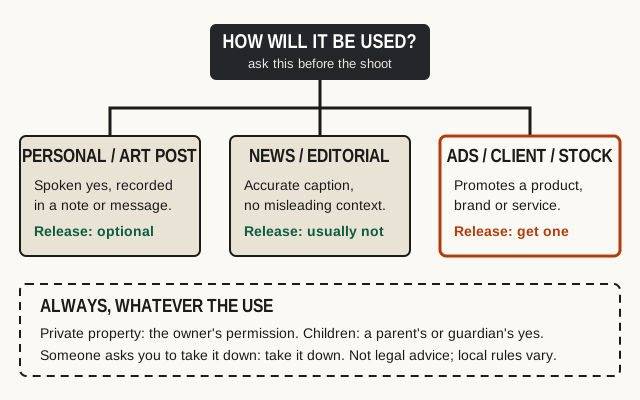
Using the photo is where consent and releases matter. The key question is what kind of use it is.
The United States
There is no federal law on using someone's likeness. Instead, most states recognize a right of publicity, either by statute or through court decisions. New York's Civil Rights Law and California's Civil Code section 3344 are the best-known examples. In broad terms, they stop you from using a person's name or likeness for advertising or trade without consent.
That is why the line between commercial and editorial use matters so much in the US. Courts have generally protected newsworthy, educational and artistic uses: a portrait in a news story, a photo book, a gallery show, or a personal post on social media. Using the same portrait in an ad, on product packaging, or in a way that suggests the person endorses something is a different matter, and that is where you need a signed release.
A few other legal ideas can catch photographers out even when the use is editorial:
- Intrusion: Photographing someone where they reasonably expect privacy, such as through a bathroom window or into a home from outside with a long lens, can be unlawful even if you never publish the picture.
- False light and defamation: A caption that misrepresents someone ("a local drug dealer," "a homeless man," when it isn't true or isn't yours to say) can create liability. Write captions that describe what is visible and what the person told you, and nothing more.
- Property rules: Private owners, including shops, malls and many offices, can set conditions on photography or ask you to leave.
The United Kingdom
UK law has no general "image right." Famous people can sometimes stop a business using their image to imply endorsement (the legal term is passing off), but an ordinary person in a street portrait has no standalone right over their likeness.
Privacy is protected in other ways:
- Misuse of private information: Courts ask whether the person had a reasonable expectation of privacy in what the photo shows. Ordinary public scenes usually pass. Photos that reveal health, a home's interior or details about children deserve more care, and courts have taken children's privacy especially seriously.
- Data protection: A photo of an identifiable person is personal data. Purely personal or household use falls outside the UK GDPR. Using images in a business, a client project or a commercial account brings it in, though the Data Protection Act 2018 has exemptions for journalism, art and literature. If you run a photography business, read the Information Commissioner's Office guidance.
- Harassment: Repeatedly following or photographing someone who has asked you to stop can be an offense under the Protection from Harassment Act 1997.
For advertising, UK industry rules (the CAP Code, enforced by the Advertising Standards Authority) generally expect marketers to get permission before featuring identifiable members of the public. A signed release is the normal way to show that.
When spoken consent is enough
For most portraits shared on X as personal or editorial work, a clear spoken yes is what photographers rely on in both countries. Make that yes meaningful:
- Say where the photo will go. "On X, which is public" is the honest version.
- Ask how they want to be named: by name, by handle, or not at all.
- Offer to send them the photo, and get a way to reach them.
- Write it down. A message afterward, like "Thanks for the portrait on Elm Street today. As agreed, I'll post it on X without your name," costs ten seconds and creates a record.
When to get a signature
Get a signed model release when any of these apply:
- The image will be used in an ad, on a product, or to promote a business, including your own photography business.
- A client is paying for the shoot and will use the photos for marketing.
- You plan to license the image through a stock agency. Agencies generally require releases for any recognizable person in commercial collections.
- The person is under 18. A parent or guardian signs.
What a basic release covers
Most releases are a page long. Templates from photographers' organizations and stock agencies are a good starting point, and many photographers use release apps that collect a signature on a phone. A typical release names:
- the photographer and the person photographed, with contact details
- the date and place of the shoot, and a short description of the images
- what uses are allowed (editorial, commercial, advertising, stock) and for how long
- whether the person is paid, even a nominal amount
- the signature of the person, or a parent or guardian for a minor
Keep the release with the original files. If you can't find the paperwork, you don't have a release.
The decent standard
The law sets the floor. Plenty of photographers set a higher bar for themselves: they don't post anyone who looks vulnerable, they remove photos when asked even when they don't have to, and they never identify a person's home. Those choices keep the people you photograph safe, and they keep strangers willing to say yes to the next photographer who asks.
Questions
Do I need a model release to post a street portrait on X?
In the US and the UK, a non-commercial post of a portrait made in a public place usually does not need a signed release. It is still wise to ask the person, and a release becomes necessary once the image is used to advertise or sell something.
Can a verbal agreement count as consent?
For personal and editorial sharing, spoken consent is what most photographers rely on. Record it: a short message afterward that says what you agreed is far better than nothing if questions come up later.
Who signs a release for a child?
A parent or legal guardian. In both the US and the UK, treat anyone under 18 as needing a parent or guardian's signature, and get a parent's agreement even for informal sharing.